For many families thinking about moving to Syracuse—or relocating within Central New York—school districts are one of the most important variables in the decision-making process. Academic outcomes matter. Long-term value matters. And for most buyers, the question isn’t simply “Which school is ranked highest?” but rather:
What am I actually trading off between school quality, home price, size, and location?
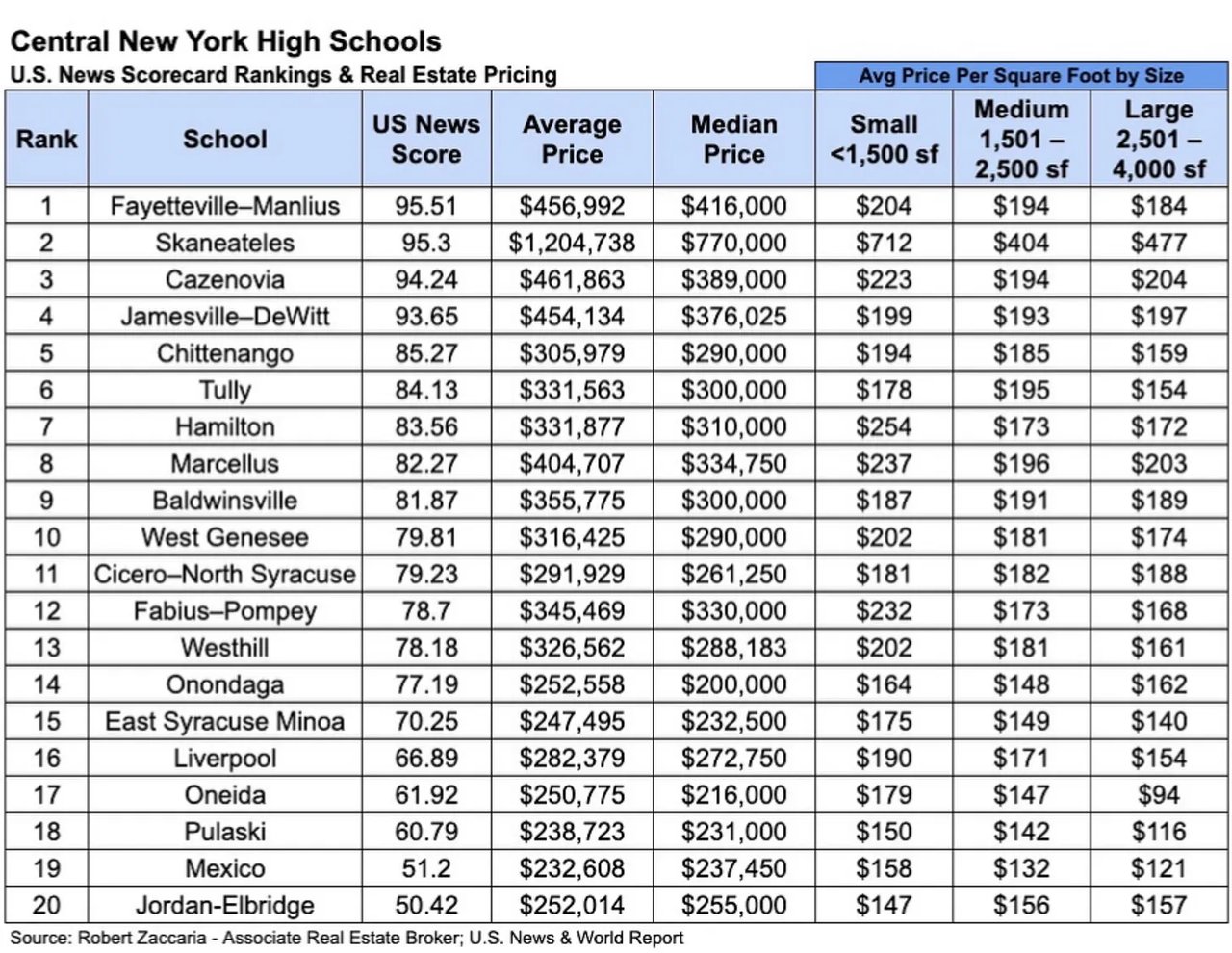
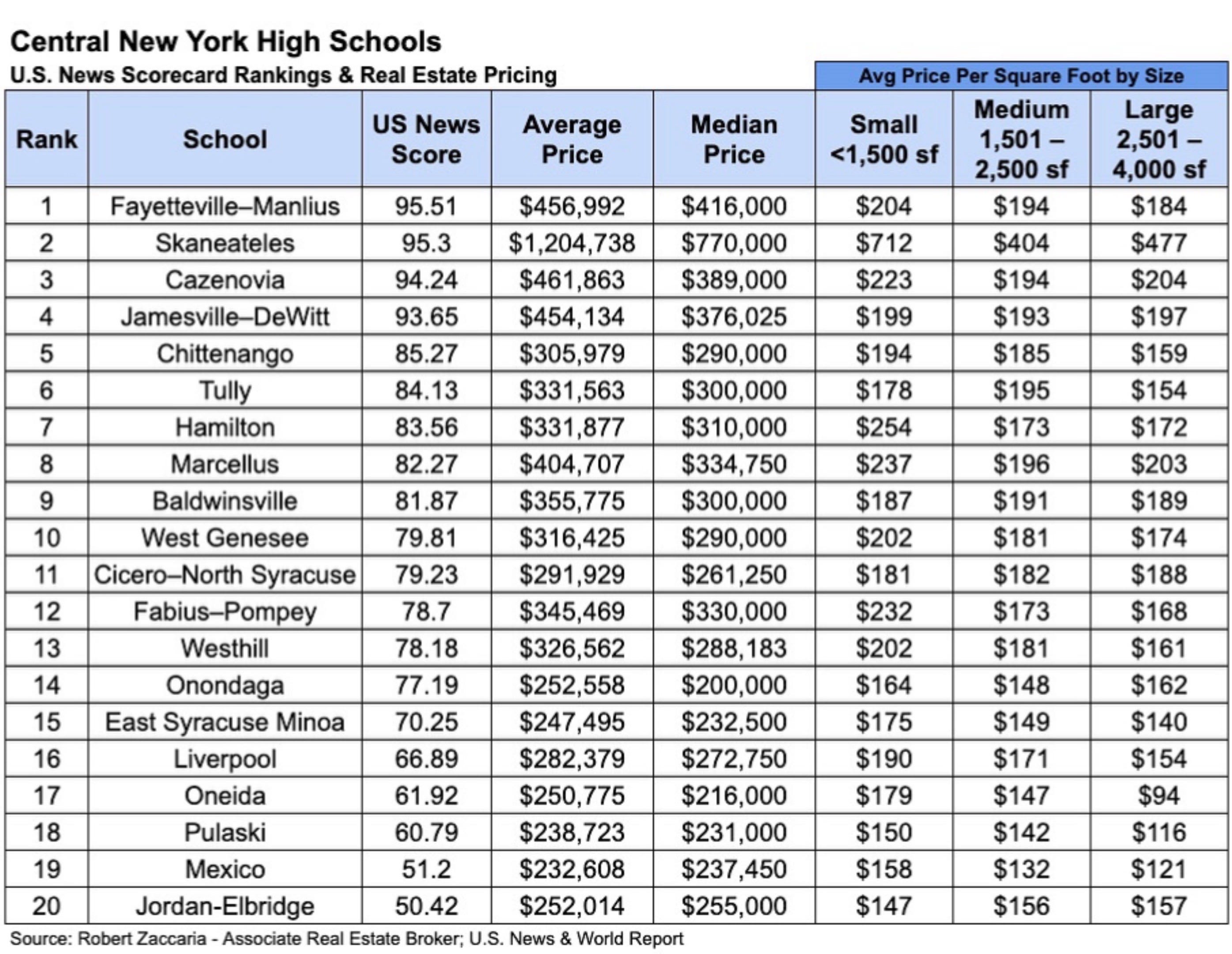
To help answer that question, I compiled the table above, which brings together U.S. News & World Report academic outcome scores with real estate pricing data across the region’s major school districts. The goal isn’t to tell you where to live—it’s to give you a clearer framework for thinking through your options.
What this data shows (and what it doesn’t)
This table focuses only on academic outcomes, not subjective factors like culture, sports, extracurriculars, or “feel.” U.S. News scores are based on measurable metrics such as:
- Graduation rates
- Regents and standardized test performance
- AP/IB participation
- Performance of underserved student populations
On the housing side, the data looks at:
- Average and median home prices by district
- Average price per square foot, broken down by home size:
- Small (<1,500 sf)
- Medium (1,501–2,500 sf)
- Large (2,501–4,000 sf)
That size breakdown is important, because buyers don’t experience affordability in the abstract—they experience it through what kind of house they can actually buy.
Academic rankings matter—but they don’t translate evenly into price
One of the biggest takeaways from this data is that school rankings and home prices are related, but not linearly.
Yes, districts with stronger academic outcomes generally command higher prices. But the jump in cost between districts isn’t incremental—it happens in tiers.
For example:
- Moving from a mid-70s score to an ~80 score often results in a modest price increase.
- Moving into the top academic tier (low- to mid-90s) can create a much larger pricing jump, depending on location and housing stock.
This means buyers shouldn’t assume that a small difference in ranking equals a small difference in cost—or value.
Skaneateles: elite academics + lifestyle premium
Skaneateles stands apart in this data.
Academically, it performs at the very top of the region. But its home prices—particularly price per square foot—are in a category of their own. That’s because Skaneateles pricing reflects more than schools alone. It combines:
- Top-tier academics
- Lake access and views
- Limited inventory
- High-net-worth demand
From a real-estate perspective, Skaneateles is best understood as a luxury market that also happens to have an elite school district. For some buyers, that combination is exactly the point. For others, it’s important to recognize how much of the price is driven by factors beyond academics.
Fayetteville-Manlius: a benchmark for “school value”
Fayetteville-Manlius (FM) is one of the most useful districts to look at analytically.
It ranks at the very top academically, yet its median home price is dramatically lower than Skaneateles. From a real estate perspective, FM shows what top-tier academic outcomes alone tend to cost in Central New York—without a large lifestyle or luxury overlay.
For buyers who prioritize academics first and want to preserve flexibility on home size, budget, or proximity to Syracuse, FM often emerges as a strong value option.
The middle-upper tier: strong academics, more balance
Districts like Cazenovia, Jamesville-DeWitt, Marcellus, and similar peers form a broad middle-upper tier:
- Strong academic outcomes
- Median home prices generally in the $330k–$390k range
- Price-per-square-foot figures that remain relatively stable across sizes
This is where many families land when they’re looking for a balance between school quality, affordability, and lifestyle. These districts often allow buyers to move up in house size—or reduce commute time—without sacrificing academic performance in a meaningful way.
Why size matters more than most buyers expect
Looking at price per square foot by home size reveals an important dynamic:
- Smaller homes tend to command the highest $/sf
- Larger homes often come at a discount on a per-square-foot basis
In practical terms, this means:
- In higher-priced districts, buyers often trade size for location or schools
- In more affordable districts, buyers can often gain significant square footage without a dramatic change in academic outcomes
Understanding this helps families make intentional decisions instead of being surprised by what their budget “buys” in different areas.
What this table is meant to help you do
This data isn’t about finding a single “best” district. It’s about helping you answer questions like:
- Do I want the very highest academic ranking, or the best academic value?
- Am I willing to trade square footage for location or school prestige?
- Does my budget go further in a slightly lower-ranked district without meaningfully changing outcomes?
- Where does lifestyle (walkability, lake access, commute) factor in?
When buyers understand these tradeoffs upfront, they tend to make more confident, durable decisions—and avoid regret later.
Final thought
School districts matter. But they’re part of a larger equation that includes price, home size, location, lifestyle, and long-term flexibility. The right choice isn’t universal—it’s personal.
The goal of this table is to make those tradeoffs visible, so families can choose intentionally, with clear eyes and good information.
If you’d like help interpreting this data for your specific situation—budget, family needs, commute, or long-term plans—that’s where a more personalized conversation becomes valuable.

Contact Me
Robert Zaccaria
Associate Real Estate Broker
Finger Lakes | Sotheby’s International Realty
Phone: 315.436.1298
Email: [email protected]
Linkedin: https://www.linkedin.com/in/robertzaccaria/
Instagram: https://www.instagram.com/rob_the_realtor_syracuse/
