

Moving to Central New York: A Homebuyer’s Guide to the Syracuse Metro
When someone tells me they are moving to Syracuse, my first question is usually: Where will you need to be on a Tuesday?
The answer might be Upstate Medical, Syracuse University, downtown, the airport, or a job at a microchip plant in Clay. Then I ask what they want their life outside work to look like. Some buyers picture a village where they can walk to dinner. Others want a four-bedroom house with a garage, a larger lot, or a lake close by. These answers are more useful than an online list of “best Syracuse suburbs.”
The Syracuse metro is a collection of distinct communities across Onondaga, Madison, and Oswego counties. A home search can take you from an early-20th-century house in Syracuse to a mid-century ranch in DeWitt, a newer colonial in Clay, or a village home in Cazenovia. Similar asking prices can buy very different homes—and lead to very different tax bills and daily routines.
I work with buyers relocating from out of state, and the same questions surface again and again. Here is the map I would want them to have before they choose a suburb or book a weekend of showings.
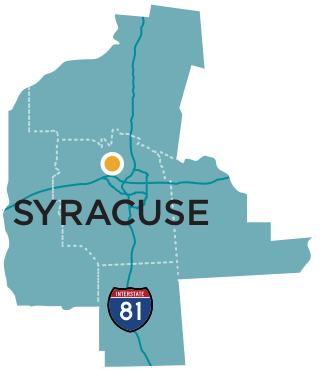
First, learn what an address does, and does not, tell you
Central New York has cities, towns, and incorporated villages. School districts cross some of those boundaries, and postal addresses cross them too. A “Syracuse” mailing address can be outside the City of Syracuse. A “Liverpool” address does not necessarily mean the property is in the Village of Liverpool. Two houses a few doors apart can be in different school districts.
That matters because the parcel’s municipality, school district, and village status help determine its taxes and services. Start with the communities that fit your commute and priorities; if a school district matters to you, filter for it. Then confirm the exact parcel through county records and the district itself. Onondaga County’s school-district map is useful for orientation, but the county labels its boundaries as approximate.
The same care applies to price. For the three months ending August 2026, Redfin reported a median sale price of about $211,000 in Syracuse city and $314,000 in Onondaga County across all home types. That difference shows why “the Syracuse median” is a poor budget for every suburb. It does not tell you what a renovated home in Fayetteville or a village property in Cazenovia will cost; Cazenovia is in Madison County and is not included in either comparison. Use recent sales of comparable homes in the actual search area to set expectations.
A buyer’s map of the Syracuse metro
The table is a starting point, not an exhaustive list of districts or a ranking of schools. Lines can cut through the larger areas named here.
Area to explore | Housing and location tradeoff | School districts to research |
|---|---|---|
Syracuse city | Historic houses, smaller homes, multifamily options, and some downtown condos; convenient to city destinations, with older-home upkeep to assess | Syracuse City |
DeWitt and Jamesville | Established neighborhoods, mid-century homes, and access to University Hill and eastern employers | Jamesville-DeWitt, East Syracuse-Minoa, and parts of Fayetteville-Manlius |
Fayetteville and Manlius | Village centers, established subdivisions, and larger or newer homes farther out; village location and specific housing features can carry a premium | Fayetteville-Manlius and other districts in the larger town |
East Syracuse, Minoa, and Chittenango | Village and suburban alternatives east of the city; compare condition, route, and county line | East Syracuse-Minoa and Chittenango, depending on address |
Liverpool, Clay, North Syracuse, and Cicero | Village homes, mid-century neighborhoods, subdivisions, and newer construction across a broad northern area | Liverpool, North Syracuse, Baldwinsville, Central Square, and others |
Baldwinsville and western suburbs | A river village, surrounding subdivisions, and established neighborhoods closer to Syracuse | Baldwinsville, West Genesee, Westhill, Solvay, and others by parcel |
Onondaga Hill, Marcellus, and the southern towns | Established homes, village options, larger lots, and more rural properties | Westhill, Onondaga Central, Marcellus, LaFayette, Tully, Fabius-Pompey, and others |
Skaneateles and Cazenovia | Historic villages, countryside, and distinct lake markets; narrow the search by actual village or waterfront needs | Skaneateles or Cazenovia in their core areas; verify outlying parcels |
Northern Oswego County edge | Smaller communities and rural properties with a longer drive to many Syracuse destinations | Central Square, Phoenix, Fulton, and others by address |
Syracuse city: character and access to city destinations
Eastwood, Sedgwick, Strathmore, Tipperary Hill, the University/Westcott area, and downtown offer different kinds of housing. You can find Tudors, foursquares, Craftsman homes, modest starter houses, two-family properties, and some condos or converted commercial spaces. A buyer who wants to reach downtown, a hospital, or Syracuse University quickly should tour several city neighborhoods rather than treating the city as a single market.
The purchase price can buy architectural detail or more space than expected. An older roof, heating system, basement, or window package can change the ownership cost, however. If schools matter, research the Syracuse City School District’s actual programs and address-specific assignments as you would any suburban district; do not let a general impression substitute for that work.
DeWitt, Jamesville, Fayetteville, and Manlius: the eastern choices
DeWitt and Jamesville often make a practical starting point for buyers commuting to University Hill or the east side. Expect mid-century ranches and split-levels, traditional colonials, mature lots, and some newer or larger homes. A house that needs kitchen and bath updates may offer a different balance of location and cost than a fully renovated one. Jamesville-DeWitt, East Syracuse-Minoa, and Fayetteville-Manlius district lines all matter in this broader area.
Farther east, Fayetteville and Manlius combine village centers with established suburban neighborhoods and homes on larger lots. The village house you can walk from and the newer colonial a drive away are different purchases. Buyers sometimes pay for a particular combination of location, condition, size, and school district, then discover they need to compromise on one of those features. Define which one matters most before deciding what is “good value.”
East Syracuse and Minoa deserve a look alongside those searches, particularly if your work is east of the city. Chittenango, in Madison County, extends the comparison farther east with village and surrounding-town options. A lower asking price only helps if the commute, condition, taxes, and eventual maintenance also work for you.
Liverpool, Clay, North Syracuse, and Cicero: many different northern searches
The north has some of the metro’s broadest variation in housing. Liverpool offers an actual village, while the much larger Liverpool mailing area includes properties outside it. North Syracuse has established neighborhoods near the airport. Clay and Cicero add subdivisions, newer homes, and a range of lot sizes; the Brewerton area brings Oneida Lake into the picture.
Do not use these names interchangeably in a listing search. A Liverpool mailing address may be in Salina or Clay. Parts of the broader northern area are served by Liverpool, North Syracuse, Baldwinsville, Central Square, or another district. If you are relocating for a job in Clay, map the work site: a house in the same town is not automatically the easiest commute.
Baldwinsville, Camillus, and the west: village life or established suburban housing
Baldwinsville centers on a Seneca River village, with suburban and more rural options in surrounding towns. Camillus and Fairmount offer established streets and a mix of ranches, split-levels, and colonials. Westvale is another close-in western option. Marcellus, Jordan, and Elbridge shift the search toward smaller villages and countryside.
These communities do not occupy a single price tier. A village location, a newer build, a larger lot, and an updated interior can each change the comparison. They also create different routes to downtown, western employers, and the lakes. Check school boundaries carefully, particularly around West Genesee, Westhill, Solvay, Baldwinsville, Marcellus, and Jordan-Elbridge.
Onondaga Hill and the southern towns: space with property-level questions
Onondaga Hill has established neighborhoods as well as larger properties in some areas. Farther south, LaFayette, Tully, and the Fabius-Pompey area can expand the search to more land and a wider variety of houses. The tradeoff may be a longer or hillier drive, a private well or septic system, more snow removal, and greater variation in the condition of outbuildings and grounds.
This is where a house’s systems deserve as much attention as its rooms. Confirm the water and sewer setup, driveway maintenance, heating fuel, and school district for the particular parcel.
Skaneateles: separate the village, lake, and surrounding town
Skaneateles can mean a historic home near the village center, a house in the surrounding countryside, or a waterfront property. Each has a different buyer pool and set of comparables. A lake view, access rights, and direct frontage are distinct features; a listing’s use of the word “lake” does not tell you which you are buying.
If village access is your priority, compare homes inside the village with other village sales. If waterfront is the priority, examine the frontage, access, site, and house together. Widening the search into the surrounding town may open up more space or different house styles, but verify the school district rather than assuming every Skaneateles address is the same.
Cazenovia: a full part of the Syracuse-area search
Cazenovia belongs on the list for buyers considering a village and lake setting east of Syracuse. The village has older homes and an Albany Street center; the surrounding town opens the search to different lot sizes, countryside properties, and other home styles. Cazenovia Lake adds another distinct market. As in Skaneateles, a village home, a lake view, and actual waterfront access should not be priced as though they were the same feature.
Cazenovia is in Madison County. The village and much of the town are served by Cazenovia Central School District, but outlying addresses need to be checked. Use Madison County’s property records for tax research. If you expect to commute to downtown Syracuse or University Hill, test that trip from the homes you are considering, at the times you would actually travel. A village-center estimate will not answer the question for a rural property.
The Oswego County edge: widen the map deliberately
Central Square, Phoenix, and Fulton can enter a search when a buyer wants to compare more house or land against a longer trip to Syracuse. Parts of this northern edge are also worth examining for a job in Clay. These places have their own districts and property-tax records, and snowfall and drive times can differ materially by address. Treat them as additional choices when they serve your routine, not as automatic substitutes for a home closer to the city.
The house matters as much as the community
A useful shortcut for understanding CNY housing is to look at when the house was built:
- Older city and village homes often offer distinctive architecture and layouts. Look carefully at foundations, electrical and plumbing updates, insulation, and the work behind renovated finishes.
- Mid-century ranches, capes, and split-levels are common in established suburbs. They may offer manageable layouts and mature lots, with kitchens, baths, windows, or mechanical systems still to update.
- Later suburban colonials often deliver the bedroom count and attached garage buyers expect, but condition and lot quality vary considerably within a subdivision.
- Newer homes may offer more updated layouts and systems. Compare the finished house and lot—not just the base price—when considering new construction.
In any era, ask how the listed square footage is measured. Finished lower-level space can be useful living space, but it should be identified separately from above-grade area when comparing homes. Review the roof, heating fuel and age, basement moisture, drainage, driveway, and public versus private water and sewer. Ask for utility history where available. A lower purchase price can lose its advantage if the immediate work and annual costs are substantially higher.
Property taxes: compare the whole payment
This is one of the first subjects I cover with an out-of-state buyer. A CNY property can have county, town or city, school, village where applicable, and special-district charges. Taxable assessments and exemptions may also differ. The postal city and asking price are not enough to predict the bill.
For a home you are seriously considering, review the actual recent bills and identify which exemptions the current owner receives. Ask the lender to estimate your payment and escrow. New York’s STAR benefit for an eligible new homeowner is a credit that requires registration.
The arithmetic can change a shortlist. A $6,000 annual tax difference is $500 per month. To illustrate the scale, at an assumed 6.5% rate over 30 years, borrowing an additional $40,000 adds about $253 to monthly principal and interest. A different home with $3,000 less in annual taxes offsets roughly $250 of that amount. Down payment, insurance, heating, maintenance, and the actual loan terms still matter, but this is why I compare total ownership cost rather than sticker price alone.
Onondaga County, Syracuse city, Madison County, and Oswego County maintain property-record resources. Verify the school, municipal, village, and special-district components for the parcel. If the assessment raises a question, speak with the assessor; New York also has a formal process and local deadline to contest an assessment.
Commute and winter: test the route, not the town name
There is no reliable “commute from Cazenovia” or “commute from Baldwinsville.” It depends on the exact house and destination. A downtown office, Upstate Medical, an eastern business park, the airport, and a work site in Clay can reorder the same list of homes.
Put real addresses into a map at your expected morning and evening travel times. Drive the route if you can. Consider the other trips that shape your week: a second workplace, the airport, groceries, or a village you expect to visit regularly. The I-81 Viaduct Project is also changing parts of the road network around Syracuse, so check current routes rather than relying on an old commute estimate.
Winter deserves a practical review of each property. Syracuse’s 1991–2020 normal annual snowfall at the airport is about 128 inches, but snow conditions vary across the region and from storm to storm. Look at driveway slope and length, parking, drainage, the route’s hills, and who handles plowing. A manageable winter at one property can mean a very different routine at another.
What about Micron and competition for homes?
Micron’s semiconductor project in Clay is a major regional development. The company began construction on its first New York fabrication plant in 2026 and describes plans for up to four plants over more than 20 years, with potential investment of up to $100 billion. It is reasonable for buyers to consider how their work and travel patterns may change as the project develops. It is not possible to turn a long-term project plan into a reliable forecast for an individual home’s resale price.
The immediate market is competitive enough to merit preparation on its own terms. In Redfin’s August 2026 Onondaga County figures, about 68.5% of homes sold above their list price. That is a countywide measure, not a prediction for the house you like. Get pre-approved, study recent comparable sales, and decide in advance which conditions and inspection findings would change your offer. The right response to competition is a well-supported decision, not an automatic waiver of protections.
Questions I hear from relocating buyers
“Why does everyone mention an attorney?” Real estate attorneys commonly handle contract review and closing work in New York. Bring one into the process early enough to explain the contract you are signing, the applicable deadlines, and the closing costs. Your agent, lender, and attorney each have different jobs.
“Can we search remotely?” Yes. Video tours, floor plans, records, and local inspections can help you eliminate properties. If possible, make one scouting trip to compare the communities themselves. Seeing a Fayetteville village street, a Clay subdivision, and a Cazenovia country road on the same visit can resolve questions that listing photos cannot.
“Should we pick a school district before a town?” If a particular district is a firm requirement, include it in the initial search filter. If it is one consideration among several, compare district programs and assignments alongside housing and commute options. In either case, confirm eligibility and the assigned schools with the district for the exact address.
“What should we budget beyond the mortgage?” Taxes, insurance, utilities, snow removal, and an appropriate reserve for the house’s age and systems. For a rural or lake property, add the costs of maintaining its land, access, and private systems as applicable.
How I would narrow your search
Start with three decisions: the destinations you need to reach, the kind of daily setting you want, and the monthly cost you are comfortable carrying. Add any firm school or property requirements. Then build a small comparison set:
- Choose two or three search areas with meaningfully different tradeoffs—for example, a close-in neighborhood, a village, and an area where your budget may buy more space.
- Review recent sold listings in each. Compare similar house types and condition, not just median prices or current asking prices.
- Tour the communities and test the routes. A scouting day can rule out an area before you fall for one house there.
- Underwrite each finalist. Confirm its district and jurisdiction, full taxes, utility history where available, condition, and likely near-term work.
- Decide what you will trade. An older kitchen for the location you want? A longer commute for acreage? A smaller home for village access? Make that choice deliberately.
There is no single best Syracuse suburb, and a Cazenovia buyer and a Clay buyer may make equally sound decisions at the same budget. The goal is to find the part of Central New York where the house, routine, and total cost work together. If you are relocating, I can help you compare actual sold homes across the communities that fit your priorities and build a shortlist before you spend a weekend touring the wrong ones.
Robert Zaccaria
Associate Real Estate Broker | Finger Lakes Sotheby’s International Realty
Call or text: 315-436-1298
