Introduction
The Onondaga County housing market in 2025 cannot be summarized with a single headline.
Depending on where you live, or where you’re thinking about buying or selling, the story ranges from rapid price acceleration to quiet normalization, from tightening inventory to growing buyer choice. In other words, this was not one market, but many, each shaped by local demand, price point, lifestyle appeal, and the simple reality of how much (or how little) inventory exists in a given town.
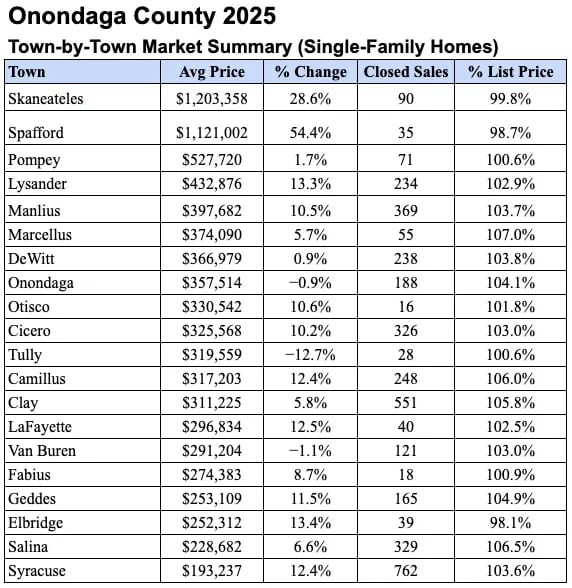
This report breaks the county down town by town to explain not just what happened, but why it happened, and what that means for the year ahead. You’ll see where prices continued to climb despite higher interest rates, where buyers quietly gained leverage, and where headline statistics can be misleading without proper context.
Whether you’re a homeowner wondering about value and timing, a buyer trying to understand competition and opportunity, or simply someone who cares about how our local market is evolving, this report is designed to give you clarity. It avoids sensationalism, focuses on real trends, and treats each town as its own market—because that’s exactly what Onondaga County has become.
What follows is a clear, grounded look at how 2025 reshaped the local housing landscape, and how those shifts may influence decisions in 2026.
Skaneateles
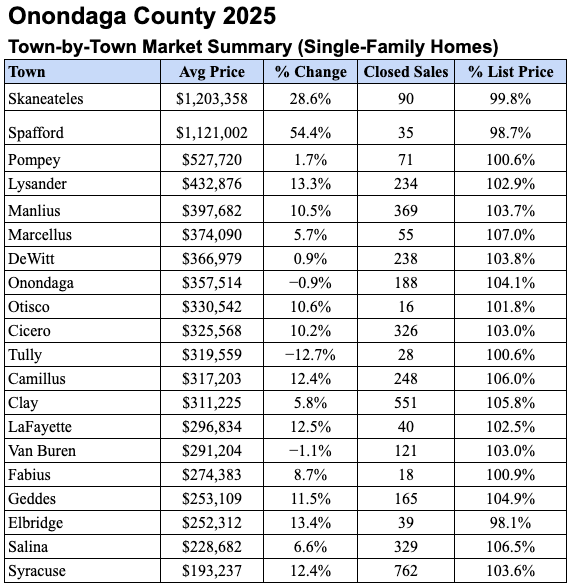
Skaneateles remains its own category. Year-to-date pricing surged, with both median and average prices up roughly 30 percent. Activity increased and days on market improved, but supply loosened substantially as inventory and months of supply rose. That combination is the profile of a premium market that stayed resilient even as more listings came on.
For sellers, demand is there, but buyers are sophisticated. They will pay for quality, but they will not overpay for flaws. For buyers, more inventory means more choice, but not necessarily lower prices.
Spafford
Spafford was the outlier rocket ship this year, with massive price increases, a big jump in closings, and tightening supply. Even with list-to-sale ratios under 100 percent, pricing power clearly strengthened, suggesting meaningful high-end demand showed up.
For sellers, premium positioning matters, including marketing, staging, photography, and reach. For buyers, expect fewer deals and more pricing that reflects lifestyle appeal rather than pure value.
Pompey
Pompey looked like a market with strong demand, as both pending and closed sales rose, but with more balanced pricing dynamics. The median price was essentially flat year-to-date while the average ticked up, and list-to-sale ratios eased.
That pattern suggests buyers were willing to pay for the right homes, but were not chasing everything. For sellers, quality still sells. For buyers, there is a bit more leverage on homes that are not prime.
Lysander
Lysander had a classic tight-market-with-rising-prices year. Closed sales edged up, prices climbed with both median and average increasing, and inventory tightened.
What stands out is that competitiveness held steady, with list-to-sale ratios roughly flat. That suggests the market did not blow off the top. It simply moved higher in a controlled way.
Manlius
Manlius looked like a market normalizing from peak intensity. Prices rose strongly and sales increased, but days on market and supply both rose as well.
The takeaway is that this is still a seller-leaning market, but pricing and presentation matter more than they did during the peak frenzy. Automatic over-ask outcomes are less universal, and buyers have slightly more room to negotiate on homes that are not turnkey.
Marcellus
Marcellus is fascinating. Inventory remains very tight, months of supply are low, days on market improved significantly, and list-to-sale ratios jumped. At the same time, the median price dipped slightly while the average rose.
That combination often happens when fewer mid-tier homes trade hands and the most desirable homes sell quickly. For sellers, if your home is in the most wanted bracket, the market is still extremely strong. For buyers, do not expect leverage simply because the median price is slightly down.
DeWitt
DeWitt was steady but slightly slower. Closed sales were flat, listings and pendings declined, and days on market increased. The median price rose, but the average barely moved, which points to a shift in the mix of homes that sold. Fewer big-ticket closings can flatten the average.
For sellers, the ceiling is still high, but the market rewards a disciplined list strategy. For buyers, this remains one of the better quality-suburb areas to look for opportunities on homes that need updates.
Onondaga (Town)
Onondaga quietly improved market speed, with days on market dropping materially. Sales rose and the market stayed highly competitive, with list-to-sale ratios remaining very strong.
At the same time, the median price was flat and the average dipped slightly, another example of mix effects at work. For residents, the market is active. The pricing story depends heavily on which segment of the market you are in.
Otisco
Otisco saw fewer sales and pendings, but prices rose sharply year-to-date and supply increased. This is a telltale sign of a thin market where the mix of homes sold drives pricing metrics more than broad demand trends.
For sellers, you cannot assume last year’s pricing applies to your home without a tight, relevant comp set. For buyers, improving selection may create more opportunities, especially if you are ready to act quickly on the rare top-tier listing.
Cicero
Cicero stayed very healthy. Listings, pendings, and closings all increased, and price growth remained strong. Days on market rose and supply loosened, but that combination reflects normalization rather than weakness.
This is still a good market, just less frantic. Sellers can still expect strong outcomes if the home shows well. Buyers may finally see more second chances as inventory circulates.
Tully
Tully shows why headline price statistics can mislead. Prices were down year-to-date, but closings were up and supply appeared tight, with low months of supply in the December snapshot.
That pattern usually means the prior year included a few unusually high-end sales that lifted the baseline. For sellers, buyers are active but price-conscious. For buyers, Tully may offer more negotiating room than the North and East suburbs if affordability is a priority.
Camillus
Camillus is one of the cleanest examples of a strong but healthier market. Median and average prices rose solidly, days on market improved, sales were essentially flat, and competitiveness remained extremely high, with list-to-sale ratios over 106 percent year-to-date.
Inventory increased, but the market still reads seller-favorable. Condo activity dropped sharply even as condo prices rose, which is a good reminder that condos need to be interpreted separately from single-family homes.
Clay
Clay stayed strong on pricing, and the market is still moving fast, but activity cooled slightly with fewer listings and pendings.
For sellers, this remains a market where good homes get rewarded. For buyers, preparation still matters. Lender strength and decisive offer terms continue to make a difference.
LaFayette
LaFayette’s big story is slower market time and rising supply, even though prices held up. When days on market nearly double and months of supply increase, that is an early signal of balance forming.
For sellers, success is still possible, but it has to be earned through preparation and pricing. For buyers, this is the type of market where inspection and concession conversations become more realistic.
Van Buren
Van Buren was softer relative to many suburbs, with activity down and prices slightly lower year-to-date. At the same time, supply tightened.
That combination often signals a thin market that is sensitive to what types of homes come up for sale. For sellers, avoid testing the market with aggressive pricing. For buyers, this can function like a patient buyer’s market inside a broader seller-leaning county, especially if you are flexible on finishes.
Fabius
Fabius is a reminder of how quickly low-volume markets can flip. Listings and sales surged year-to-date, prices jumped, and inventory disappeared in the December snapshot.
For residents, one or two high-quality listings, or the absence of them, can swing the data dramatically. For buyers and sellers, comparable sales must be handled carefully. Overgeneralizing from a thin dataset is risky.
Geddes
Geddes posted an interesting combination. Prices rose strongly, sales increased modestly, and days on market rose, but months of supply actually tightened.
That often means buyers were still absorbing inventory even as the pace slowed. For sellers, well-located homes continue to command a premium. For buyers, slower days on market does not automatically mean cheaper. It may simply mean more time to inspect and decide, if you are ready.
Elbridge
Elbridge is the clearest shift signal so far. Months of supply more than doubled, list-to-sale ratios fell below 100 percent, and the median price declined while the average rose, a classic mix effect.
This reads like a market where buyers gained leverage, especially on homes that need work or are priced aspirationally. Sellers should treat 2026 as a year that rewards presentation and pricing discipline.
Salina
Salina quietly shifted this year. Prices rose modestly, but the bigger story is that inventory and months of supply jumped and days on market increased.
That is a real signal that buyers have more options. Sellers can still do well, but in 2026 Salina may be one of the markets where overpricing gets punished fastest.
Syracuse (City)
The city’s story is fewer transactions and higher prices. Closed sales were down year-to-date, and listings and pendings declined as well, but both median and average prices climbed meaningfully.
For sellers, pricing power is still real, but buyers are more selective. Condition and location matter more than they did at peak frenzy. For buyers, the city remains one of the best places to find relative value, but you still need to move quickly on top-quality inventory.
Two cross-town insights buyers and sellers should pay attention to
1) 2026 is shaping up to be a pricing-discipline year in more towns.
You can see this wherever supply and days on market rose, including Salina, Manlius, Cicero, LaFayette, Elbridge, and Skaneateles. In those markets, sellers who overreach are more likely to sit.
2) Onondaga County is no longer one market.
Premium towns like Skaneateles and Spafford behave very differently from core suburbs such as Manlius, Cicero, Camillus, and DeWitt, and differently again from low-volume rural towns like Fabius, Tully, and Otisco.
Conclusion
The most important takeaway from 2025 is that Onondaga County is no longer moving as a single housing market. What happened this year depends heavily on where you are, what you own, and what you are trying to do. Premium towns behaved like premium markets, core suburbs settled into a more sustainable pace, and lower-volume rural areas showed just how quickly conditions can swing when inventory is thin.
For sellers, the era of automatic outcomes is fading in many towns. Pricing, preparation, and presentation matter more than they did even a year ago. Homes that are well positioned continue to sell quickly and competitively, while those that are mispriced or poorly presented are far more likely to linger. The market is still capable of rewarding sellers, but those rewards are becoming more selective.
For buyers, conditions are quietly improving. In several towns, increased inventory and longer days on market are creating space for due diligence, inspections, and more thoughtful decision-making. That does not mean prices are falling across the board, but it does mean leverage is beginning to reappear in specific segments and locations.
As the market moves into 2026, success will depend less on broad headlines and more on local knowledge. Understanding how your specific town is behaving, how your price point fits into current demand, and how today’s buyers and sellers are making decisions will matter far more than countywide averages. The market has not stalled, but it has matured. Those who approach it with clear expectations and informed strategy will be best positioned in the year ahead.

Contact Me
Robert Zaccaria
Associate Real Estate Broker
Finger Lakes | Sotheby’s International Realty
Phone: 315.436.1298
Email: [email protected]
Linkedin: https://www.linkedin.com/in/robertzaccaria/
Instagram: https://www.instagram.com/rob_the_realtor_syracuse/
Bio: Robert Zaccaria is an Associate Real Estate Broker with over eight years of experience in the Central New York market. Known for his consultative approach and financial insight, he has advised buyers and sellers across hundreds of transactions, earning a reputation for thoughtful strategy, strong advocacy, and sound judgment.
Prior to real estate, Robert served as a Senior Analyst on GE Capital’s Market Intelligence team, where he worked in an internal consulting role analyzing markets, evaluating risk, and supporting strategic and investment decisions across multiple business lines. He began his career in GE’s prestigious Financial Management Program (FMP), an intensive two-year leadership development program spanning four rotational assignments. Today, clients benefit from this background through data-driven guidance, actionable market insights, and disciplined pricing and negotiation strategies that bring clarity and confidence to complex transactions.
In addition to real estate, Robert is the co-owner of Noble Cellar, one of Central New York’s most acclaimed fine-dining restaurants. Building an award-winning hospitality brand from the ground up refined his understanding of service, presentation, and experience. These qualities naturally extend to how he represents homes and cares for clients. His approach balances precision and professionalism with warmth, attentiveness, and genuine connection.
Robert holds a Master of Public Administration from Syracuse University’s #1 ranked Maxwell School, a Bachelor of Science in Finance and Marketing Management (summa cum laude) from Syracuse’s Whitman School of Management, and a professional certificate in Real Estate from NYU’s Schack Institute of Real Estate. He is a past recipient of the Greater Syracuse Association of Realtors’ Shining Star Award, a distinction awarded annually to one agent across the region for excellence in professionalism, service, and community leadership.
Highly communicative and detail-oriented, Robert serves as a trusted advisor throughout every stage of the process. Whether navigating a competitive acquisition or positioning a property for maximum value, he brings calm judgment, sharp negotiation skills, and a level of care that allows clients to move forward with confidence.

Finger Lakes Sotheby’s International Realty
44 East Genesee Street, Skaneateles, New York, 13152 United States
